
Meaning and Description
The episcopal coat of arms is a reflection of Bishop Victor R. Scott’s faith, heritage, and ministry.
The portcullis arch door stands as a reminder that the gospel is not merely the way into the Christian life but the very life itself. It signifies openness to God’s will, the call to evangelism, and the Church as the means by which people enter into the fullness of faith.
The coquí frog, native to Puerto Rico, speaks to Bishop Scott’s cultural heritage and personal identity, evoking memories of his childhood and representing perseverance, transformation, and humility. Accompanying it is the Thespesia Grandiflora, Puerto Rico’s national flower, a vibrant emblem of both his roots and the beauty found in God’s creation.
At the heart of the shield, the pelican in her piety, a cherished Christian symbol, recalls Christ’s self-sacrificial love and the Eucharist, and is flanked with the Greek letters Alpha and Omega in gold on either side. First encountered in a Methodist church where he served, this image has remained a profound source of inspiration throughout his ministry.
The colors of the arms—gold for divine wisdom, red for sacrifice, and green for renewal and the pastoral calling of a bishop—further emphasize the themes of faithfulness, service, and redemption.
Above the shield, a gold processional cross rises. The entire design is topped by a green ecclesiastical hat (galero) with six tassels hanging on each side. Beneath the shield, a white scroll bears the Latin motto, IĒSUS EST EVANGELIUM in black, meaning ‘Jesus is the Gospel’.
Rooted in historic Christian tradition while reflecting a deeply personal journey, this coat of arms embodies Bishop Scott’s calling to proclaim the gospel, serve God’s people, and remain steadfast in Christ’s love.
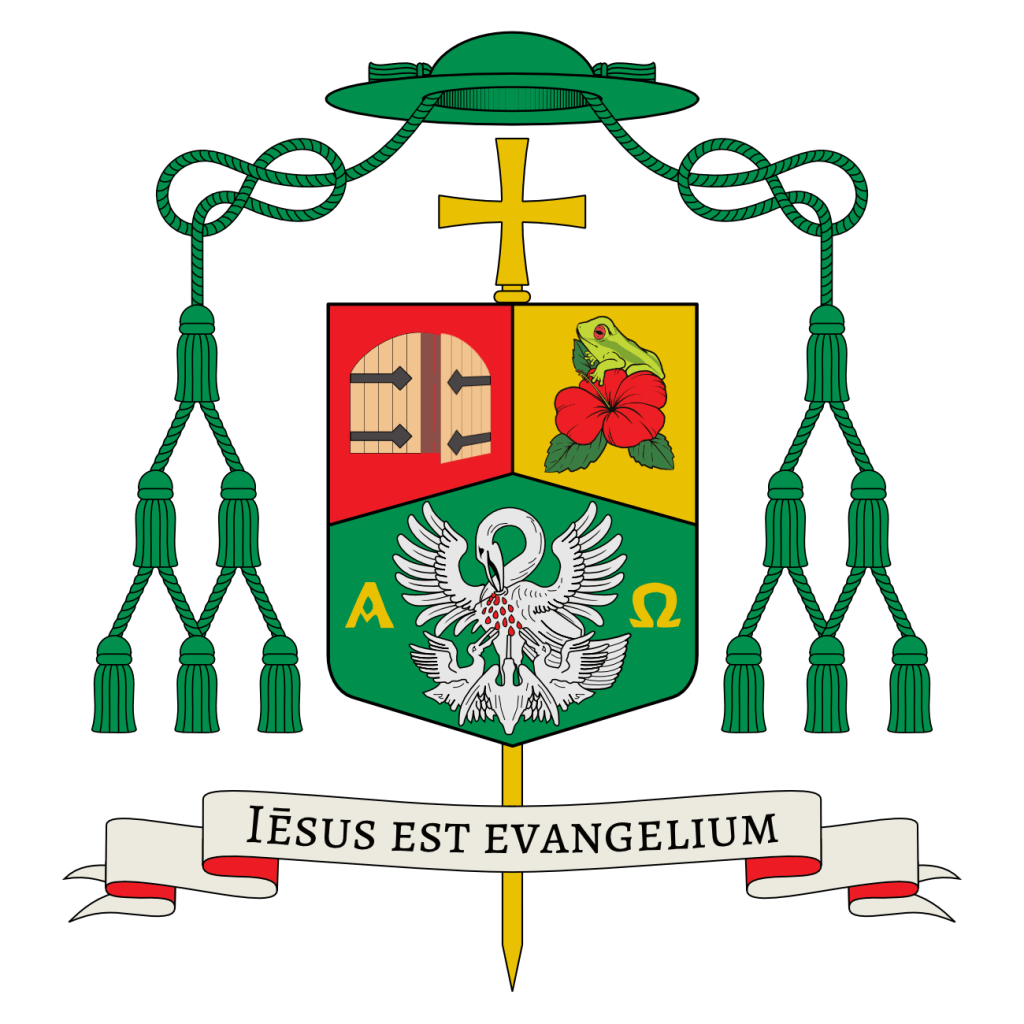
 Bishop Victor R. Scott